born to run
revisiting the book that launched thousands of ultrarunners and several lawsuits

During my first distance race after moving to El Paso, Texas, I passed a mother and daughter pair at around the halfway mark. This was notable to me for two reasons: one, the woman was fairly old and I was running pretty fast; two, they were dressed in flowing robes and wearing sandals. The latter observation stuck out more. Thus, my introduction to the Tarahumara/Raramuri people came during a city marathon. After the race, I googled around a bit to find out what I could but it was 2008 which, while not that long ago, was an era when finding stuff on the Internet was more difficult.
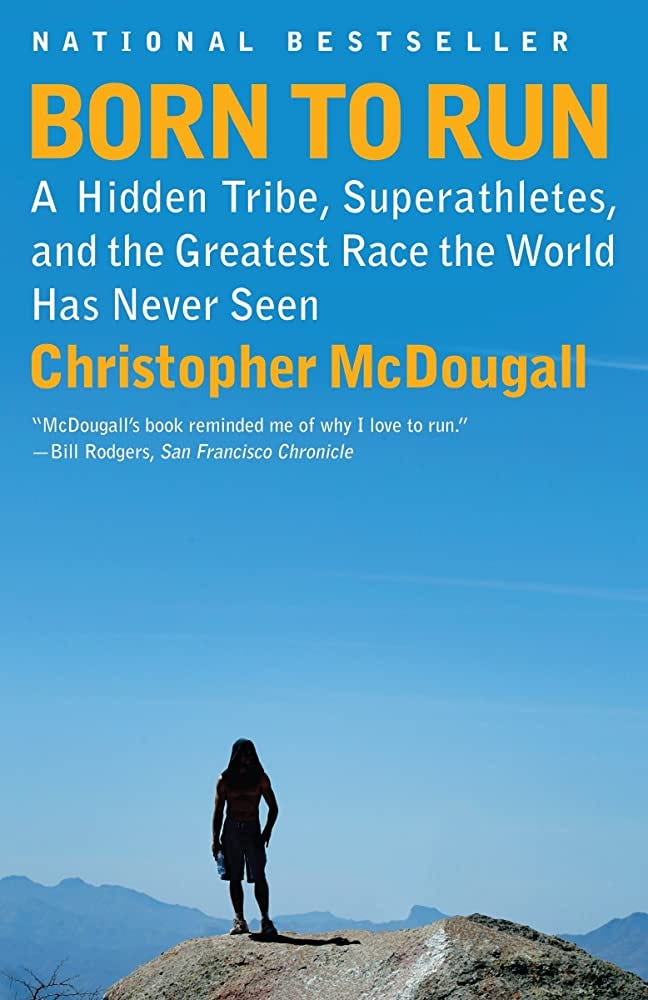
Therefore, when Born to Run by Christopher McDougall, subtitled A Hidden Tribe, Superathletes, and the Greatest Race the World Has Never Seen, came out in the summer of 2009 I snapped it up. The Hidden Tribe of the title is the Tarahumara people. They are some of the superathletes described. And the titular race took place in their homeland: the Copper Canyon of Mexico.
I was so enamored of the book that I packed it in my backpacking pack while my wife and I traipsed through the Olympic Peninsula in Washington with her sister on our annual summer trip and read it by firelight to them. Both the sports science elements and the human narrative utterly compelled me. And, in small ways, it changed my life. Clara and I signed up for our first ultramarathon after reading it. I worried for the first time in my life about my footstrike while running. I searched for pinole recipes and bought chia seeds to take on long runs (note: they did not work for me as described). I also became something of an evangelist for the book, recommending it to everyone I thought might like it as well as people I was sure would not.
Oddly enough, for someone who frequently re-reads books, I had not re-cracked the spine of McDougall’s work until a couple of weeks ago while we took a much less active road trip through the Midwest. I was honestly a bit nervous to return to it. I wrote a post last year on the experience of re-reading and the importance of growing up with books. The subject then was of a different caliber, Dostoevsky’s The Brothers Karamazov. In that post I waxed euphoric about the pleasure of reading something after a long interval. Sometimes, though, when you read a book a second time, the feeling is not one of expansion and depth and maturity but a bit of shame or confusion: why did this book mean so much to me when it did? I had a feeling Born to Run might belong to that latter category. I drank deeply of its Kool-Aid. How would that taste 15 years later?
The answer: not very sweet.
Here are a few of the things that struck me as utterly bizarre, even downright charlatan/carnival-barker about the book on the second read.
1. Barefoot Running & the Claim That Led to Lots of Foot Injuries
This is probably what the book is best remembered for. McDougall launches an all-out attack on Nike, Bill Bowerman, cynical marketing, and cushioned running shoes, arguing that the prevalence of foot injuries in the running community is directly linked to our comfortable shoes.
It’s a somewhat convincing narrative, especially for someone like me who mistrusts so much of modern culture. Do we need new shoes as frequently as we’ve been led to believe? Surely not. Do we need all the gel and cushioning heaped in shoes? Harder to say, but also probably not. I am trail-running in Hokas right now and they are awesome. Brooks tinkered with the Cascadia in the latest release and I can no longer wear them for longer than three miles without getting blisters. It’s a bummer. I’ve worn those shoes since college. I still love the Nike Pegs for the road and wear a pair of Nike Frees (a sort of minimalist shoe) once a week or so.
What happened when people read the book and started hitting the trails in Vibram Five Fingers is a lot of foot injuries (the usual suspects, plus some cuts and scrapes). Vibram was sued for misleading customers into thinking their barefoot-ish shoes were safe and would prevent injury. Thank God I never fell that deeply into the book’s vortex. Partially, this is because I lived in El Paso, Texas. El Paso is not exactly hospitable to barefoot running—every damn thing in the desert looks like it wants to kill you. I did like to kick off my shoes and run barefoot on a football field or in a park after a run, but I had no intention to run in the Franklin Mountains in a thin piece of plastic.
But a lot of people bought the claims and immediately converted from running on pillows to running basically barefooted. And they got hurt. Even if you want to make the case that we shouldn’t be running in puffed-up, over-padded shoes it does not stand to reason that you go straight to barefoot running. Our modern world is not exactly designed for barefoot running. We’re not cruising the savannahs in Africa, after all.
I can’t believe McDougall thought barefoot running was the panacea he described in the book. For one, he only marginally practiced it himself, more on my wavelength of barefoot strides rather than an ultra in Five Fingers. For another, it just doesn’t make sense to think that we can suddenly change the way our feet interact with their environment without any consequences. No, he saw an opportunity to bash a big company and make outlandish claims—this will end injuries!—rather than the more banal claim that our ancestors lived barefoot and maybe we should think about restrenghtening our feet.
2. The Mysterious Raramuri and the BS Possible in an Earlier Era
The whole Tarahumara shtick in this book reads like an old-school anthropology text. It’s very much in the noble savage or athletic savage vein. The Tarahumara regularly appear out of thin air and then melt back into the canyons. They are skittish like frightened animals when the slightest social faux pas is committed. And, of course, they are all athletic freaks. Well, all except the ones who have now been Westernized. Those are all fat, lazy slobs like the average American.
There are hints in the book that there is more rot in the culture than McDougall let on—he references their annual binge-fest but makes it sound more like a harmless Purge-style release rather than the violent and rapacious event it actually deteriorates into—but for the most part, he makes them out to be a sort of ideal culture just across the border. This is one of those things that was easier to pull off 15 years ago. With social media and greater access to scholarly literature (Tarahumara culture was studied before McDougall and pals went for their run), there is far less mystery to unpack. The first scholarly study of the Tarahumara was published in 1893. Anthropologists regularly live down in the canyon for years at a time. People have been on this for a while, but because most Americans had never heard of the Tarahumara in 2009, McDougall was able to present the people as a sort of fable of the perils of modernity (just like the shoes modern businesses were forcing us to lace up).
Again, he had to know he was fudging reality here. The Tarahumara do have an amazing running culture; they do seem to have participated in persistence hunts until recently. However, McDougall has to make them out to be the noble savages pointing us out of our own civilized malaise. They can’t just be them; they have to be a canvas on which rich, fat, white people can project their own cultural assumptions.
3. Ultrarunning as Balm for Society
One of the funny things about following the ultrarunning community is seeing the way it has changed since the book’s publication. To say that ultrarunning was a niche sport is to be generous. Today, though, there is money in the game. This is partially because of McDougall’s book, but also because stars like Kilian Jornet and Courtney Dauwalter have made a name for themselves. Now, I don’t think anyone gets rich running ultras, but you can at least be a professional ultramarathoner these days. Which is great for the people at the top of the sport. Before 2009, there were a couple of figures—Pam Reed and Dean Karnazes—famous mostly for their stunts (50 marathons in 50 days, running on a treadmill in Times Square, etc.). Neither was the best ultrarunner; they crushed the competition in self-promotion.
McDougall pitches ultrarunning as the cure for society’s ills. Because he romanticizes the Tarahumara, he’s able to imagine that if we, too, all started running on old tires through canyons then our culture, too, would achieve harmony just like those happy little natives. He thus elevates each of the figures that accompanies the group to Mexico with a status similarly mythical to that which he builds for the Tarahumara. Scott Jurek was a legitimately great runner and a seemingly good dude. Everyone else on the trip was mostly a flash in the pan. And, honestly, this tends to be the case for ultras because longevity in the sport turns out to be more difficult than McDougall alleges.
One of the most bizarre claims he makes is that ultrarunning is better for your body than conventional running. Watching figures like Tony Krupicka, Geoff Roes, Rob Krar, and other high-profile runners be hobbled after a few years of stunning success would belie McDougall’s claims. It turns out that running insane distances isn’t very good for your body. Who would have thought?
But, for McDougall’s story, he has to make ultrarunning the key to salvation with the Tarahumara as the prophets of our redemption. So, he acts like since he was able to power through a single 50-mile race in 12 hours that he has somehow unlocked a health cheat code. From what I can tell online, he hasn’t run an “ultra” longer than a 50k since his original Copper Canyon jaunt. Perhaps it wasn’t the balm he presented it to be.
And I guess that’s my main frustration on re-reading the book. I love running. I am still enraptured by the big distances and spend more time contemplating them than I deserve given my own lack of race fitness. Part of me still harbors ambitions of running a 100-miler before I get too much older. But it saddens me that the main book that put ultrarunning on the map was written by a dilettante who saw a marketing opportunity rather than an afficionado and practitioner of the discipline.
Maybe that’s fine. That happens. Journalists come in and stake out their ground. What that leads to, though, is books like Born to Run. They take on a Malcolm Gladwell-esque “this explains everything” tone and do little justice to the subject at hand. They do this because they don’t actually know or understand the subject at hand. They dip in, do a bare amount of research, and shout their findings from the rooftop. A credulous public (all too often me) fall for the show, having checked our critical faculties at the door. A more honest book wouldn’t have sold as well but at least it would have been, well, honest.